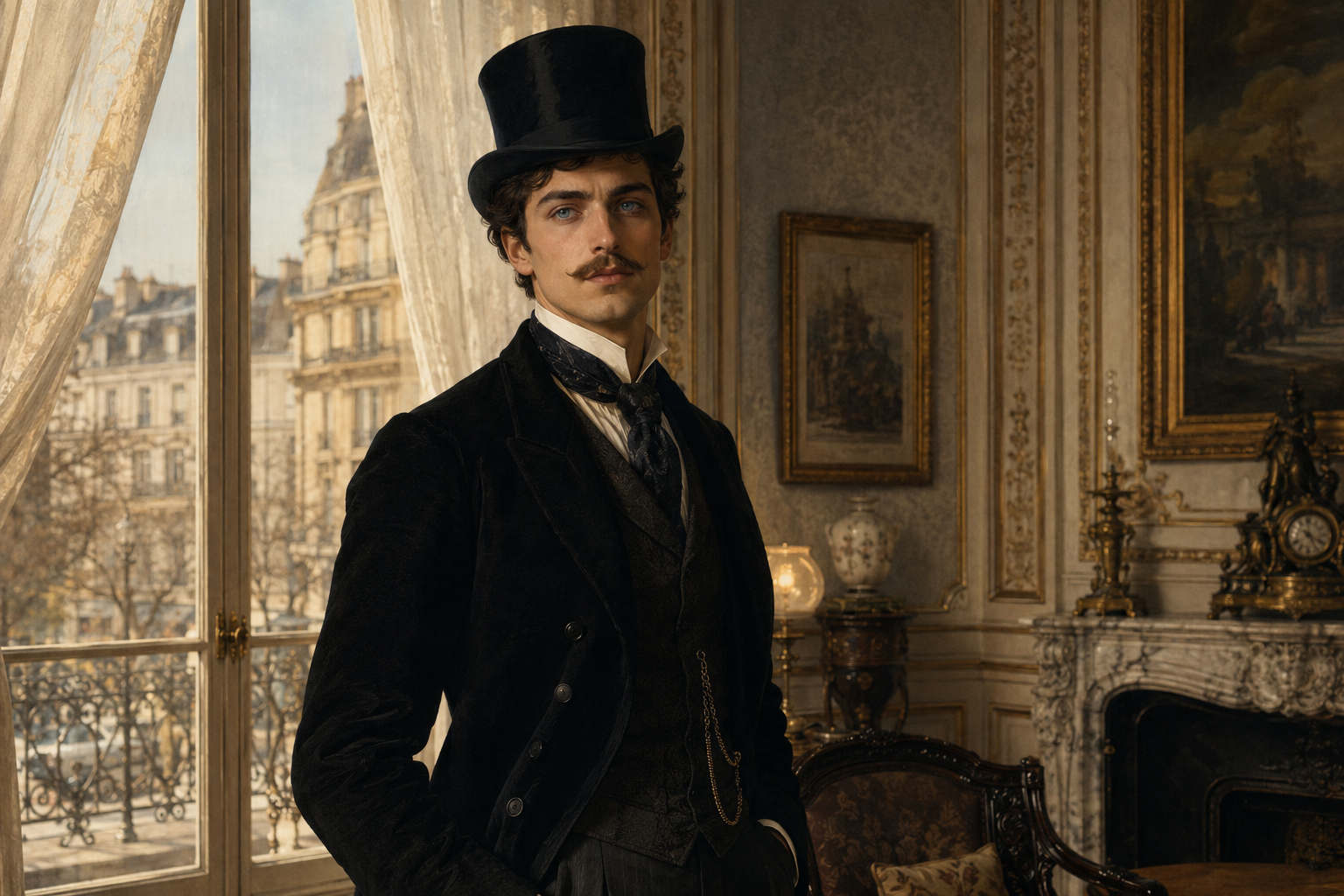
The 2012 adaptation of Guy de Maupassant’s Bel-Ami is a decent film; it’s well-acted, visually polished, and reasonably faithful to the novel’s main events. I don’t think it deserves as low a rating as it’s gotten. But its biggest departure from the book isn’t a missing scene or a renamed character – it’s that the film gives Georges Duroy an excuse.
In Maupassant’s novel, Duroy is a genuine scoundrel. People help him, women love him, and opportunities keep falling into his lap. He doesn’t turn ruthless because society humiliates him; he’s ruthless because ambition, vanity, and resentment were already there in him. The film weakens this by making the men around him obviously hostile and demeaning.
Charles Forestier is the clearest example. In the film, he seems unhappy about Duroy showing up at the newspaper, and treats him like an unwelcome rival; you come away thinking Duroy was slighted from the start. In the novel, though, Forestier genuinely helps his old army buddy. He lends him money, introduces him around, gets him into journalism, opens up a whole world that would have stayed closed to him otherwise. Forestier can be rude, sure – but that’s just because he’s sometimes a rude man, not because he’s running some campaign to humiliate Duroy.
Monsieur Walter – renamed Rousset in the film – gets the same treatment. The film makes him openly contemptuous toward Duroy, so that later, when Duroy seduces Madame Rousset, it plays almost like payback against a man who’s had it coming.
The novel is subtler and more psychologically interesting. Walter isn’t out to get him. Duroy is just touchy about his own position, because he’s replaced Forestier both at work and at home; his colleagues call him “Forestier” as a joke, since Madeleine writes for him the same way she once wrote for her first husband. His suspicions about Madeleine – her attachment to the Comte de Vaudrec, later her affair with Laroche-Mathieu – only make it worse. Most of the humiliation is in his own head. Other people poke at his insecurities; they don’t put them there.
That distinction matters. In the film, Duroy’s cruelty keeps coming across as reactive. In the novel, it’s just who he is.
His affair with Madame Walter best shows the difference. The film frames the seduction partly as revenge on her husband. The novel doesn’t; Duroy goes after her because she’s another conquest, and a satisfying one, since she’s respectable, religious, and resistant at first. He wants to prove he can have her, that’s all. There’s no real justification for it, and that’s exactly what makes the scene more disturbing – and more revealing.
Funny enough, while the film invents provocations to make Duroy’s worst behavior more understandable, it cuts something that makes him a little better in the novel: his relationship with his parents. The film barely touches on this, mostly just to mention that they need money. In the novel, Duroy isn’t ashamed of them at all, even once he’s moved up in the world – he sends them money, takes Madeleine to visit them in Normandy. He’s selfish and calculating in nearly every other relationship, but he’s not an ungrateful son. Cutting that out doesn’t make the film’s Duroy more complicated; it just makes him unpleasant across the board.
Robert Pattinson isn’t bad in the role, but he’s not my Georges Duroy. Maupassant’s Duroy is tall, well-built, and can make almost anything look good on him. More importantly, he’s got an easy charm that hides how calculating he is; at first he can even come across as naïve. It’s not that women overlook his moral failings because he’s handsome – they’re drawn in by the gap between how simple he seems and how sure of himself he is physically.
Pattinson shows too much contempt and calculation too early. His Duroy often looks like a thug who’s already decided how he’s going to use everyone in the room; the menace shows before the charm has had a chance to work. That makes it harder to buy why so many intelligent women fall for him. The novel’s Duroy is dangerous precisely because he doesn’t always look dangerous.
The supporting cast is generally strong, but the film moves through the story too fast. Some of that was probably unavoidable – Maupassant’s novel has too many relationships, political schemes, newspaper intrigues, and stages of Duroy’s rise to fit comfortably into a feature film. Still, I wish the adaptation had spent more time on Paris itself, and on Duroy’s work at La Vie Française.
The novel’s Paris isn’t just scenery. Its boulevards, restaurants, drawing rooms, newspaper offices, churches, and fashionable events are the actual machinery Duroy climbs through. In the film, the story feels oddly detached from its setting; a lot of it could have happened in almost any European city. We get the costumes and the interiors, but not the social ecosystem of Paris, or the corrupt closeness between journalism, finance, politics, and private life.
The rushed pacing also weakens some relationships. Suzanne’s decision to run off with Duroy feels sudden, because the film never really builds their connection. In the novel, he deliberately wins her trust and sets the whole thing up over time. Without that, her decision just seems to happen because the plot needs it to.
I also missed the painting of Christ that looks like Duroy. In the novel, Monsieur Walter buys Christ Walking on the Waters, and Madame Walter becomes obsessed with how much Christ’s face resembles her lover’s. It’s religious ecstasy, erotic fixation, and moral collapse all tangled together – it shows just how completely Duroy has taken over her imagination; she can’t even look at something sacred without seeing him. It’s grotesque, exact, and hard to forget – exactly the kind of detail that might have given the film some real depth.
Despite all this, Bel Ami is still a solid adaptation. The performances are committed, the period setting looks convincing, and it keeps most of the novel’s central story intact.
It’s not the failure some of its ratings suggest. But it swaps Maupassant’s ambiguity for more conventional dramatic motivation. By making Forestier and Rousset openly hostile, the filmmakers give Duroy grievances he didn’t earn. By making Pattinson’s contempt so visible, they show us the predator before we’ve had a chance to feel the charm.
Maupassant’s Duroy is more unsettling. He’s helped, not oppressed; loved, not excluded; welcomed into a world that rewards him generously, at every turn. He destroys and betrays people not because they destroyed him first, but because he finds out he can. That’s what makes him such a memorable scoundrel – and it’s what the film, for all it gets right, never quite captures.


