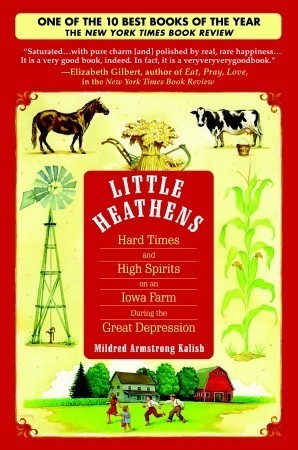
A review of Mildred Armstrong Kalish’s memoir of childhood on an Iowa farm during the Great Depression
Mildred Armstrong Kalish | Memoir | First published 2007
Mildred Armstrong Kalish’s Little Heathens: Hard Times and High Spirits on an Iowa Farm During the Great Depression is a memoir of ordinary life: family routines, household chores, farm work, school days, kitchen conversations, children’s pranks, and the countless small tasks that once held a household together. Rather than organizing her story around one dramatic event, Kalish patiently reconstructs the world in which she grew up. As she explains near the beginning, this is a story of a time, a place, and a family.
Kalish was born in 1922 on a farm near Garrison, Iowa, and spent her childhood with her mother, grandparents, brothers, sisters, and extended family. She later served in the Coast Guard Women’s Reserve during World War II, earned a university degree, and became an English professor. In the memoir, however, she returns to the perspective of Millie, the little girl she once was. The book is written in the first person, and that intimate point of view gives its descriptions both warmth and authority.
The book’s greatest strength is the density of its everyday detail. Kalish describes how food was grown, prepared, and preserved; how animals were cared for; how children contributed to farm work; and how a household functioned without modern appliances or conveniences. Recipes and practical instructions appear among the memories, giving the book the character of a memoir, a household record, and at times even a manual for a nearly vanished way of life. The photographs of Kalish, her relatives, and the places she remembers deepen that atmosphere, although I found myself wishing that the book included more of them.
Kalish’s writing is informal without becoming careless or overly conversational. Her prose is clear, expressive, and often eloquent, with very few clichés. The story moves fluidly, and despite its focus on routines and domestic work, it is surprisingly difficult to put down. Her attention to physical detail makes the past feel immediate: the reader does not merely learn what farm families did but begins to imagine the textures, smells, effort, and rhythm of their days.
The Great Depression itself remains mostly in the background. That is understandable because Kalish experienced it as a child and could not yet comprehend the economic forces shaping the adults’ lives. Nevertheless, the memoir contains brief moments when the larger crisis breaks through the security of childhood. In one of the most powerful passages, she remembers seeing adults cry after her grandfather’s brother and sister lost their farms, machinery, and livestock. She did not understand the reason at the time, but she understood the fear. Memories like this are scarce, yet they communicate what the Depression meant to ordinary people more vividly than a general explanation might.
At the same time, the book left me with an important unanswered question. Kalish’s grandparents owned several farms, some of which they rented to their daughters, as well as crop fields, livestock, and orchards. The meals described in the book are remarkably plentiful; in Russia a century ago, many of them would have been considered celebration feasts. Kalish’s family may have been more prosperous than an average farming family, even if they still worked hard and lived frugally. I would have liked the memoir to explain their financial position more fully. Was their situation typical? If it was not, how did it differ from that of neighboring families, and how did that difference shape Kalish’s childhood? Without this context, it is sometimes difficult to know how representative her experience was of farm life during the Depression.
None of this means that the family had an easy life. Every child was expected to work, and the household’s continuity depended on everyone completing the chores appropriate to their age. The adults also exercised an authority that would feel severe today. Kalish’s grandfather required her mother to leave her husband and return to the family home, and he even decided when Kalish’s nursing baby sister should be weaned. These episodes reveal more than family eccentricity: they show a household governed by duty, hierarchy, and the unquestioned power of older generations.
This book especially resonated with me because I’m drawn to history as it was lived by ordinary people—their work, food, relationships, pleasures, and everyday worries. Having spent part of my own teenage years on a farm, I found many of Kalish’s memories unexpectedly familiar. My experience took place more than sixty years later, in another country and on a much smaller farm, yet I recognized the care of animals, the unpleasant necessity of butchering them, outhouses, long walks to school, and even the task of collecting Colorado potato beetles. Kalish remembers dropping the insects into kerosene and describes the work as repulsive; I found the same chore rather entertaining. These personal points of recognition enriched my reading, but the book remained fascinating even where Kalish’s world was entirely unfamiliar to me.
The life she describes also made me a little envious. I would not want my son to grow up under exactly the same conditions, but I understand the appeal of a childhood with so much freedom, closeness to nature, simple and nutritious food, and days filled with meaningful tasks. Kalish sometimes suggests that this world has disappeared completely: children no longer eat berries directly from the branches, animals no longer wander through backyards, and families no longer live with the same closeness. Here I see things somewhat differently. Small farms like hers still exist, and people still experience those modest moments of happiness. The world she records has changed, but it has not vanished everywhere.
By the end of Little Heathens, I felt as though I had been given a tour through time. Kalish allows the reader to observe not only farm labor but also leisure, family discipline, kitchen conversations, childhood mischief, and the quiet arrangements on which daily life depended. Because she writes about what she experienced firsthand, the memoir has the conviction and specificity of lived memory, even when its broader economic context remains incomplete.
Memoirs centered on ordinary life are essential to our understanding of history. Dates, policies, and economic explanations tell us what happened; books like Little Heathens help us understand how it felt to live through it. Reading Kalish’s memories is a little like listening to one’s grandparents and suddenly realizing that their stories are also part of one’s own inheritance. Her book preserves a world through its smallest details—and in doing so, shows why those details deserve to be remembered.


