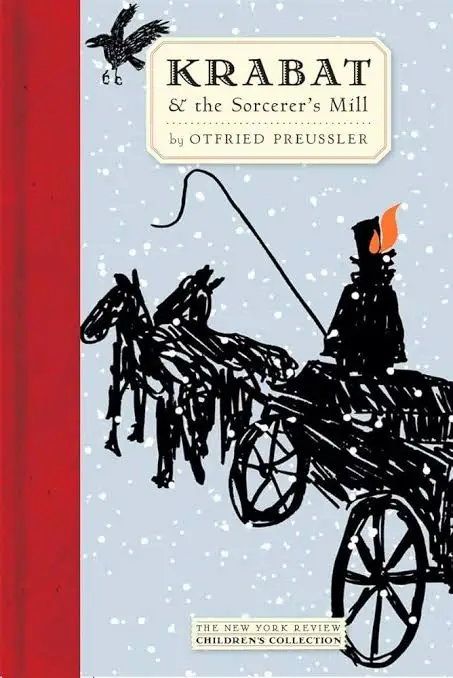
Set in rural Saxony during the Great Northern War in the early eighteenth century, Krabat and the Sorcerer’s Mill follows a young Sorbian orphan who is mysteriously drawn to an isolated mill where eleven other boys live and work. The Sorbs are a West Slavic ethnic minority whose historic homeland, Lusatia, lies within present-day eastern Germany.
Krabat soon discovers that he has become an apprentice not merely to a miller but to a powerful sorcerer. At the mill, time passes unnaturally, obedience is absolute, and the cost of learning the Master’s dark arts proves far more terrible than he imagined.
The novel creates an atmosphere that is both mysterious and dreadful. It draws the reader into this remote village: the mill is governed by exhausting work and unquestioning obedience, the villagers avoid it with palpable apprehension, and a long, bitter winter deepens its sense of isolation.
What makes the story more vivid and profound, however, is that the apprentices are still boys—young, hopeful, and mischievous. They find small opportunities to disobey the Master, though rarely to his face, and sometimes use their newly acquired magic simply to have fun. In those moments, the reader shares their delight. Each boy has a distinct personality, and the kindness, loyalty, and camaraderie among them give the story much of its emotional weight.
The story unfolds at exactly the right pace. It moves slowly enough for the reader to absorb the atmosphere and become attached to the characters, but never so slowly that it loses momentum. The underlying danger makes the novel difficult to put down.
There is also a romance that is pure, innocent, and quietly powerful—exactly what first love ought to feel like. It brings warmth and hope into an otherwise forbidding story without diminishing its darkness.
Krabat and the Sorcerer’s Mill offers an evocative glimpse into Sorbian folklore and a story that feels genuinely unlike most modern fantasy. Although written for younger readers, its atmosphere, moral complexity, and emotional depth make it equally rewarding for adults.


