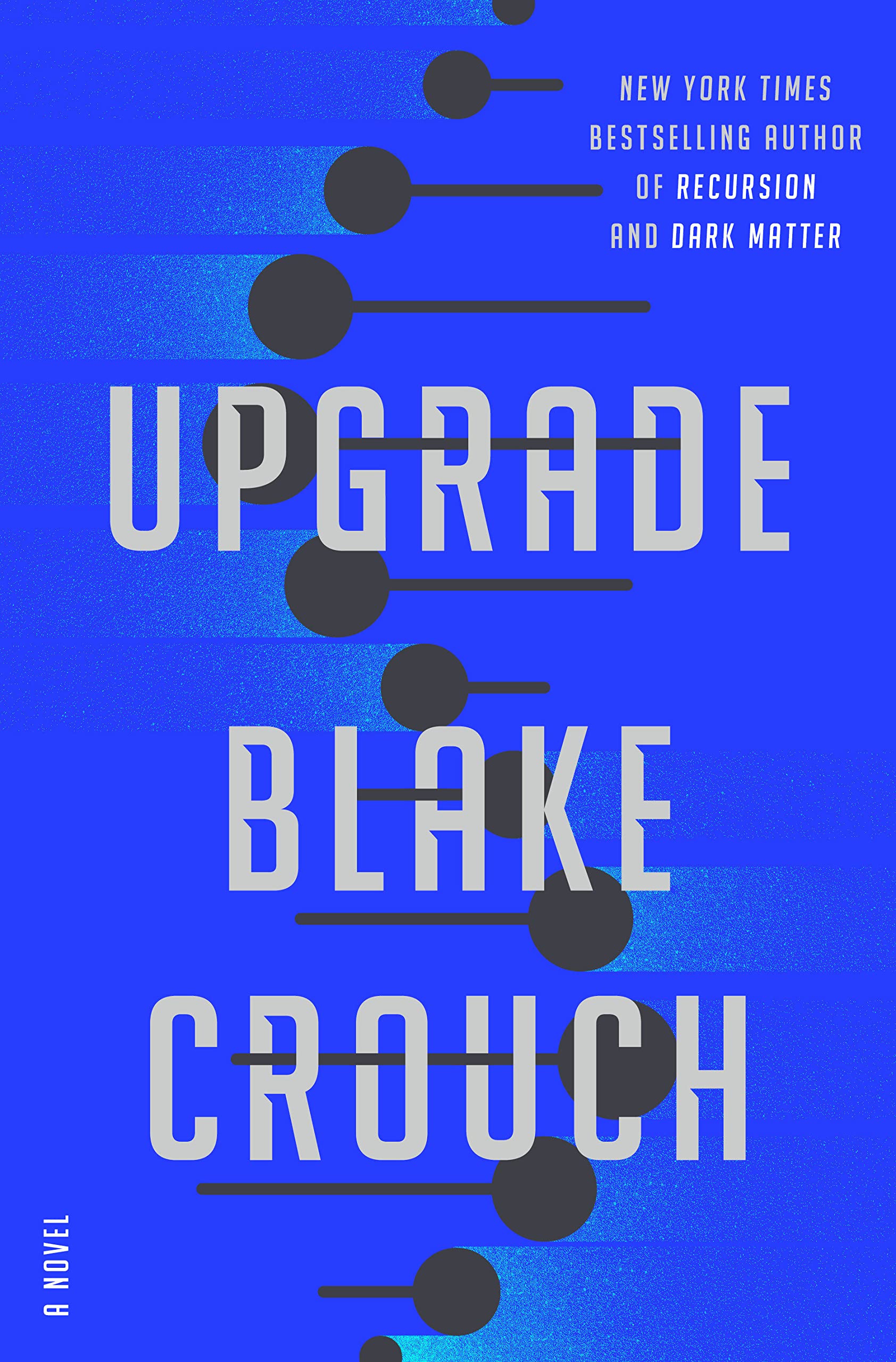
Upgrade is the third Blake Crouch novel I’ve read, after Dark Matter and Recursion, and surprisingly, it is easily the weakest of the three. I loved both of those books: they were difficult to put down, built around ideas that felt fresh, and managed to turn fairly complicated science-fiction concepts into genuinely suspenseful stories. While reading Upgrade, I actually found myself wondering whether it had been written before them, when Crouch was still developing the style that worked so well in his later novels. It turns out the opposite is true: Upgrade came afterward, which made the difference even more surprising.
The premise revolves around genetic engineering and a protagonist whose DNA is altered in a way that effectively turns him into an enhanced version of a human being. His intelligence increases, his memory becomes extraordinary, his physical abilities improve, and he begins processing information at a level ordinary people cannot. There is certainly enough material here for an interesting science-fiction novel, but unlike the central ideas behind Dark Matter or Recursion, this one never felt particularly fresh to me. The concept of genetically enhanced humans and the consequences of manipulating human evolution is familiar territory, and Upgrade did not give me the feeling that Crouch had discovered some unexpected new angle on it.
The larger problem was that I simply did not care very much about what was happening to the protagonist. Crouch spends considerable time describing his new abilities and demonstrating how much more efficiently his upgraded mind works, but the transformation never became emotionally interesting to me. He was becoming superhuman, and my reaction was essentially: good for him. There was none of the emotional urgency that made the central situations in Dark Matter and Recursion so effective. Those novels used their science-fiction concepts to intensify very human fears and attachments. Here, the concept itself seemed to receive more attention than the person experiencing it.
That emotional distance extends to the other characters as well. There are not very many of them, and most remained surprisingly flat. As a result, even the relationships that were presumably supposed to give the story emotional weight never became particularly important to me. For a thriller, there is also an unexpected sense that not very much is happening for considerable stretches of the book. A few times I seriously considered abandoning it, something that never occurred to me with either of the previous Crouch novels I read.
I also had difficulty accepting some of the book’s speculation about science and the future. Science fiction obviously does not need to predict technological development perfectly, and speculative ideas inevitably require some suspension of disbelief. But that suspension works only when the fictional science feels internally convincing enough that the reader is willing to follow it. Several ideas in Upgrade struck me as implausible to the point of being almost laughable, and once that happened, I found it increasingly difficult to trust the larger world Crouch was constructing. A science-fiction novel built so heavily around genetics and technological possibility needs its speculation to feel persuasive even when it is imaginative, and for me this one too often failed that test.
None of this makes Upgrade a terrible book. I finished it, and there were enough interesting moments to keep it from becoming a complete disappointment. It is competently written and readable, and for someone particularly interested in genetic engineering and human enhancement, the premise may be much more engaging than it was for me. The problem is that Crouch himself has already shown me how much better he can do this kind of novel.
Dark Matter and Recursion both left me with ideas I wanted to think about after finishing them, and they are books I could imagine rereading years from now. Upgrade left almost no such impression. It was fine while it lasted, but I cannot imagine ever wanting to read it again. Coming from an author whose previous two books had set my expectations so high, “fine” was surprisingly disappointing.
3/5 stars.


